Why the next big platform won't look like one.
Distribution is moving inside experiences. Superapps in Asia, games everywhere, agent surfaces emerging. The founders and teams pitching the next platform as a destination are solving the 2015 problem.
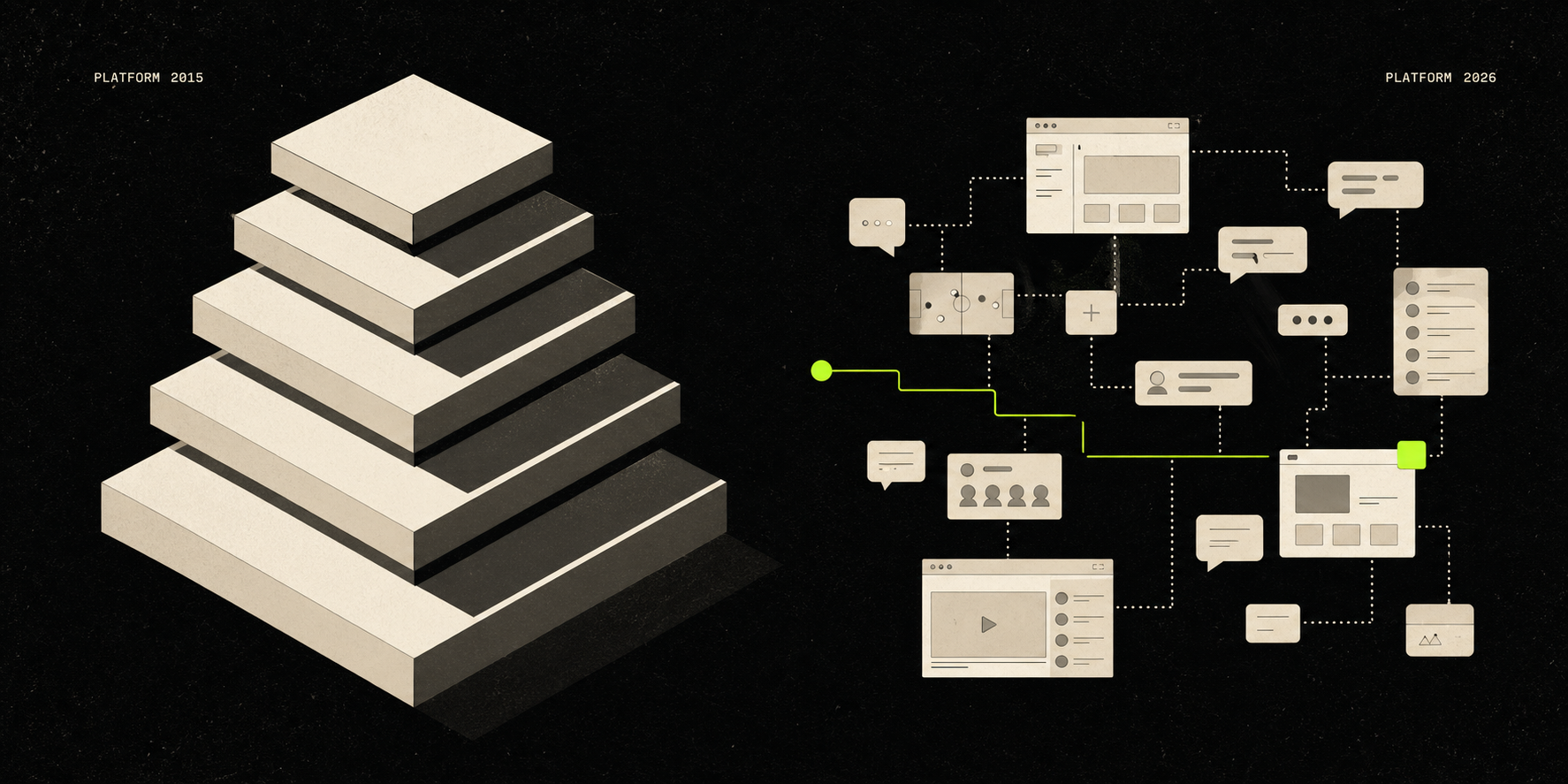
Fifteen years and I'm still arguing with myself about distribution.
The clearest version of the argument I ever lived through was Ember Sword. We built a custom engine in C++, compiled to WebAssembly, that compressed down to 2.5 MB and ran a full streaming MMO world in roughly 25 MB total. Browser tab, any device, no install, five-second cold start, 80-90% of native performance, no Steam, no patcher. The whole point was that a player should be able to try the game in five seconds on whatever hardware they already owned. If you can't deliver that, your audience is whoever's already willing to download 60 GB and create a launcher account, which is a smaller pool than people assume. Distribution is an engineering problem. The lesson stuck.
The argument runs across two companies. At Marathon Variety we advise studios on distribution. Sometimes that means Steam-first. Sometimes it means superapps or miniapps. Two of the titles we're working with right now sit on the conventional side: Ezekiel: Noa and the Automaton Urbis (steampunk-cyberpunk TPS RPG) and Star Thieves (multiplayer heist game), both Steam-first with consoles after, both betting that the PC-then-console pipeline still works for the right titles. At Brainjuice Labs, Amber and I shipped Rugs to Riches on Telegram via PlayDeck. Different audience, different storefront, different math. Monetization runs through Telegram Stars. Apple and Google still take 30% on the way through. The integration cost and audience profile are nowhere near a Steam release.
Two pipelines. One argument. Most of us keep drawing the old shape until the new one corrects us.
A team pitched me last quarter on "the next platform for creator commerce." Slide three was a stack diagram. Slide four was a TAM number with three commas. Slide eight was an app icon mocked up on a phone screen.
They were the third group this quarter (one founder, two teams) to use the word "platform" without describing a place a person would actually go.
That is the giveaway.
The word still gets thrown around like it did in 2015, when the road to a billion users ran through the App Store and the only real question was which side of the two-sided market you owned. We learned the playbook then. Most of us are still running it. The map changed. The playbook did not catch up.
Distribution moved. It moved into experiences people already live inside. WeChat in China. Roblox and Fortnite for anyone under thirty. ChatGPT for anyone over thirty who has a knowledge job. The next big platform will not be announced. It will be the surface you are already standing on, and the only question is how natively you are willing to build for it.
This article merges two arguments I keep making in client rooms, often against my younger self. The first is that the platform-as-destination model has been functionally dead for at least five years and most of us are still pretending otherwise. The second is that games figured this out a decade ago, the rest of consumer tech is finally catching up, and the agent layer is repeating the same shape now in fast-forward.
There is a self-audit at the bottom. Eight questions. It will tell you whether your project is treating distribution like 2015, 2020, or 2026. Most readers will not like the result. I did not, the first time I took it.
§ 01 The destination model is over
We are not in 2015 anymore.
Global app downloads were essentially flat in 2025. Up 0.8% across iOS and Google Play combined, on a base of roughly 136 billion installs.1 In-app purchase revenue grew 10.6% in the same window, which means the people already inside the apps are spending more, while the marginal new install gets harder to find every quarter.
The concentration is worse than the headline. In the US App Store, 94% of revenue accrues to the top 1% of monetizing publishers.2 The chart is not a long tail. It is a cliff with a rounding error attached.
What grew? Time spent inside three categories. TikTok was the worldwide leader for downloads, in-app purchases, and total time spent in 2025.3 AI assistants became the tenth-largest app category by time spent, with a 426% year-over-year jump driven mostly by ChatGPT.3 Games as a category lost share to apps for the first time. Roblox grew anyway, which we will come back to.
This is not a story about the App Store dying. The App Store works fine as a billing rail and a download layer. It is a story about the App Store no longer being the place where things are discovered, judged, or returned to. Discovery moved to TikTok feeds, Discord servers, Roblox lobbies, and increasingly into chat threads.
The store is plumbing. The party is somewhere else.
If your acquisition plan has the words "we'll go viral on the App Store," you are pitching a 2015 plan in 2026. I have done this. I have nodded along while founders pitched it. The first version of every distribution plan I helped write between 2017 and 2021 leaned on App Store rank as a North Star. The North Star moved. The plans did not.
§ 02 The model that replaced it: superapps in Asia
A superapp is a single anchor app, usually messaging or payments or rides, that opens its surface to third-party mini-apps backed by a built-in wallet. The "everything app" was not a Western invention and is not yet a Western reality. It is a working pattern across China, Southeast Asia, Korea, and Japan, with concrete economics behind it.
The shape is consistent every time. Anchor utility, then wallet, then mini-app surface, then distribution layer.
WeChat. Combined Weixin and WeChat MAU reached 1.418 billion at the end of 2025.4 Mini Programs (the third-party apps that run inside WeChat without a separate install) crossed RMB 2 trillion in transaction volume back in 2024 and grew over 70% year-on-year in the second half of 2025.56 The lesson is not that WeChat is a chat app. The lesson is that one billion four hundred million people have one log-in, one wallet, and one launcher for everything they do online, and the launcher happens to look like a thread of messages.
Meituan. Bundles food delivery, hotels, instant retail, bikes, and groceries. On-demand delivery passed 150 million daily orders in July 2025, up from a long-term IPO target of 100 million.7 Instashopping (their quick-commerce arm) hit roughly RMB 350 billion in GMV, about $48 billion.7 Meituan posted a net loss for the year because they spent the war chest defending share against JD.com and Alibaba.7 Nobody is fighting for "an app." They are fighting for control of the surface where commerce happens.
Grab. Southeast Asia's regional play. FY2025 revenue $3.37 billion, up 20%.8 Financial services crossed $1 billion in loan portfolio, and Superbank, their Indonesian digital bank, IPO'd in December 2025.8 Grab started as ride-hail. The wallet was the lever. Now they ship loans, insurance, and a digital bank, and the ride-hail is the customer-acquisition cost on the broader stack.
Kakao. KakaoPay Q3 2025 revenue grew 28%, with TPV at KRW 47 trillion and 6.56 million daily active users.9 Kakao Corp posted a record quarter at KRW 2.086 trillion in revenue.10 In a country of 52 million people, KakaoTalk is the messaging layer almost everyone uses, and the wallet is now the second behavior nearly everyone has.
LINE. 98 million MAU in Japan as of March 2025.11 The interesting move was LY Corp consolidating LINE Pay into PayPay and shutting LINE Pay down on April 30, 2025.11 Two payment surfaces collapsed into one because the surface that wins is the surface with more daily reach. PayPay had it.
The pattern across all five is identical. Anchor utility, then wallet, then opened surface to third parties. Once the surface had attention and a payment rail, every category became a tenant rather than a competitor.
The "app" was the building. The mini-app was the storefront. The wallet was the rent.
Western analogues keep failing for three boring reasons. Apple and Google control the device-level wallet and resist payment intermediation. Antitrust scrutiny in the US and EU makes bundling expensive. The cold-start on a wallet without a daily-use anchor (chat, rides, messaging) is brutal, and most Western superapp attempts have skipped that step. X tried. Meta tried. The only Western company close to the shape is Apple itself, and they got there by owning the device.
If you are a Western operator, the takeaway is not "build a superapp." Most should not. The takeaway is to stop assuming the shape of distribution looks like the App Store. In the largest consumer markets in the world, it already does not.
§ 03 Games already operate this way
Roblox is not a game. It is a country.
In 2025, Roblox averaged 127 million daily active users, peaked at 152 million in Q3, and clocked 123.9 billion engagement hours across the year.12 That is 2.7 hours per DAU per day. Revenue hit $4.89 billion, up 36% year over year. Bookings were $6.8 billion. Advertising revenue passed $100 million per quarter in Q4. Creators on the platform earned $1.5 billion collectively, and the top 1,000 creators averaged $1.3 million each, up 50% year over year.121314
Read those numbers as a country, not a game. Roblox has a population larger than every European country except Russia. It has a currency, a developer economy, a labor market, and an advertising layer. The "game" is the operating system. The experiences inside it are the apps.
I learned this the hard way.
When I wrote Ember Sword's first distribution plan, the gravity wells were Steam and the App Store. It was the right answer for the year I wrote it. By the time we shipped early access on December 2, 2024, the gravity had moved. The teen audience we wanted lived inside Roblox. The early-believer audience we had built lived inside Discord. The general gaming audience we wanted lived inside YouTube and Twitch creator funnels, summoned through clips and lobby drops. None of those surfaces were named in the plan we wrote five years earlier. We adjusted, and the adjusting was harder than the original plan, because by then every surface we had to learn was native to other people's primitives, not ours.
This was not a unique failure. It was the standard one.
Fortnite did the same thing on a different timeline. The hinge moment was December 2023, when Epic shipped Lego Fortnite, Fortnite Festival, and Rocket Racing in one week. Lego Fortnite peaked above 2.4 million concurrent players at launch, Festival hit nearly 1 million, Rocket Racing 600,000, and the parent game crossed 7.6 million concurrent players over that weekend.15 None of that was a sequel. It was Epic flipping the same lever Roblox had pulled five years earlier. Stop being a game. Start being a platform that ships games.
Disney noticed. In February 2024, Bob Iger announced a $1.5 billion investment in Epic and described it as "our biggest foray into the game space ever."16
Disney did not buy Epic. They bought a permanent installation in someone else's country.
They did not build a Disney app. They could have, easily. They are Disney. They chose, instead, to live inside Fortnite.
Netflix made the same call. In May 2024, they launched "Nextworld" on Roblox, with branded experiences for Stranger Things, One Piece, Cobra Kai, and Rebel Moon.17 A streaming company put its premium IP in a different company's game. Three years ago that would have been a marketing gimmick. In 2024 it was distribution strategy, full stop.
Brands did not need to be told twice. Gucci's Garden experience on Roblox averaged 29 minutes per visit and sold over $1.2 million in virtual items.18 Wendy's Fortnite Food Fight stunt drew 250,000 live viewers on Twitch and won a stack of awards. Nike tried to short-circuit the same thesis with RTFKT, their NFT-native sneaker brand, and shut it down in January 2025 because the model never matched the spend.19 Even the failures are instructive. The brands that succeeded built native to a surface. The ones that built their own surface, like Nike with RTFKT, kept finding out the audience already lived somewhere else.
Travis Scott's Astronomical concert in April 2020 was the cultural origin point. 12.3 million concurrent Fortnite players, the largest synchronous in-game audience ever recorded.20 Music industry coverage at the time framed it as a stunt. It was a proof of concept. The concert showed that experience-as-distribution-surface works at the same scale as broadcast television. Everything since has been refinement.
Rockstar has been telegraphing the same move. In August 2023 they acquired Cfx.re, the team behind FiveM and RedM, the multiplayer modding frameworks behind whole creator economies on GTA V and Red Dead.25 That was not a moderation acquisition. That was a creator-platform acquisition. GTA 6 ships May 26, 2026.26 If you read the trail, the bet is that Rockstar is not shipping a sequel. They are shipping a country with a creator API on or near day one. If the bet lands, GTA 6 stops competing with Call of Duty for one weekend and starts competing with Roblox for the next ten years.
I will write the full breakdown of that one when the launch lands and the creator tooling is documented. For now, watch the announcements between this article and May, not the trailers. The trailer tells you what Rockstar built. The creator tooling tells you what they think they are.
The pattern, again. Anchor utility (a game people already loved), then a payment rail (V-Bucks, Robux), then an open surface (UEFN, Roblox Studio), then a tenant economy (Lego, Disney, Netflix, Gucci, every major IP holder). Same superapp shape. Different geometry.
The lesson for non-game operators is not "build a Roblox experience." Most should not. The lesson is that the line between "platform" and "experience" has collapsed in any category where attention is concentrated. If your audience already lives inside one of these surfaces, building parallel to it is a strategic error. You either build inside it, or you build for the surface that comes next.
§ 04 The agent layer is the next surface
The pattern is repeating. Faster this time, with American characteristics.
OpenAI shipped the Apps SDK at DevDay on October 6, 2025. Pilot partners included Booking.com, Canva, Coursera, Figma, Expedia, Spotify, and Zillow.21 The architectural choice that matters: there is no separate store UI. Discovery and invocation happen inside the conversation. The app is a tool the model summons when a user's intent matches. Built on the Model Context Protocol (MCP), open standard, designed for adoption beyond OpenAI.
Anthropic shipped Agent Skills ten days later, on October 16, 2025, and opened the spec as a standard that December.22 Skills are a more developer-flavored shape (folders of capabilities the model loads on demand), and they show up across Claude's web app, the Claude Code CLI, and the API. The interesting framing is not the technical shape. It is that two of the largest AI labs converged within ten days on the same architectural answer. The chat thread is the new launcher. The apps live inside it.
Browsers are doing the same thing. Perplexity shipped Comet in July 2025, made it free worldwide in October, hit Android in November, and iOS in March 2026.23 OpenAI shipped ChatGPT Atlas in October 2025. Google rolled Gemini into Chrome last September and launched Auto Browse for paying users in January 2026. The Browser Company killed Arc and pivoted to Dia, an AI-native browser, because the shape they originally bet on was not the shape that won.24
Read these moves together. The browser, historically a renderer, is becoming a runtime. The chat client, historically a conversation, is becoming a launcher. In both cases, third-party functionality is summoned by intent, not selected from a grid. The user does not know they are using "an app." They just describe what they want and a tool runs.
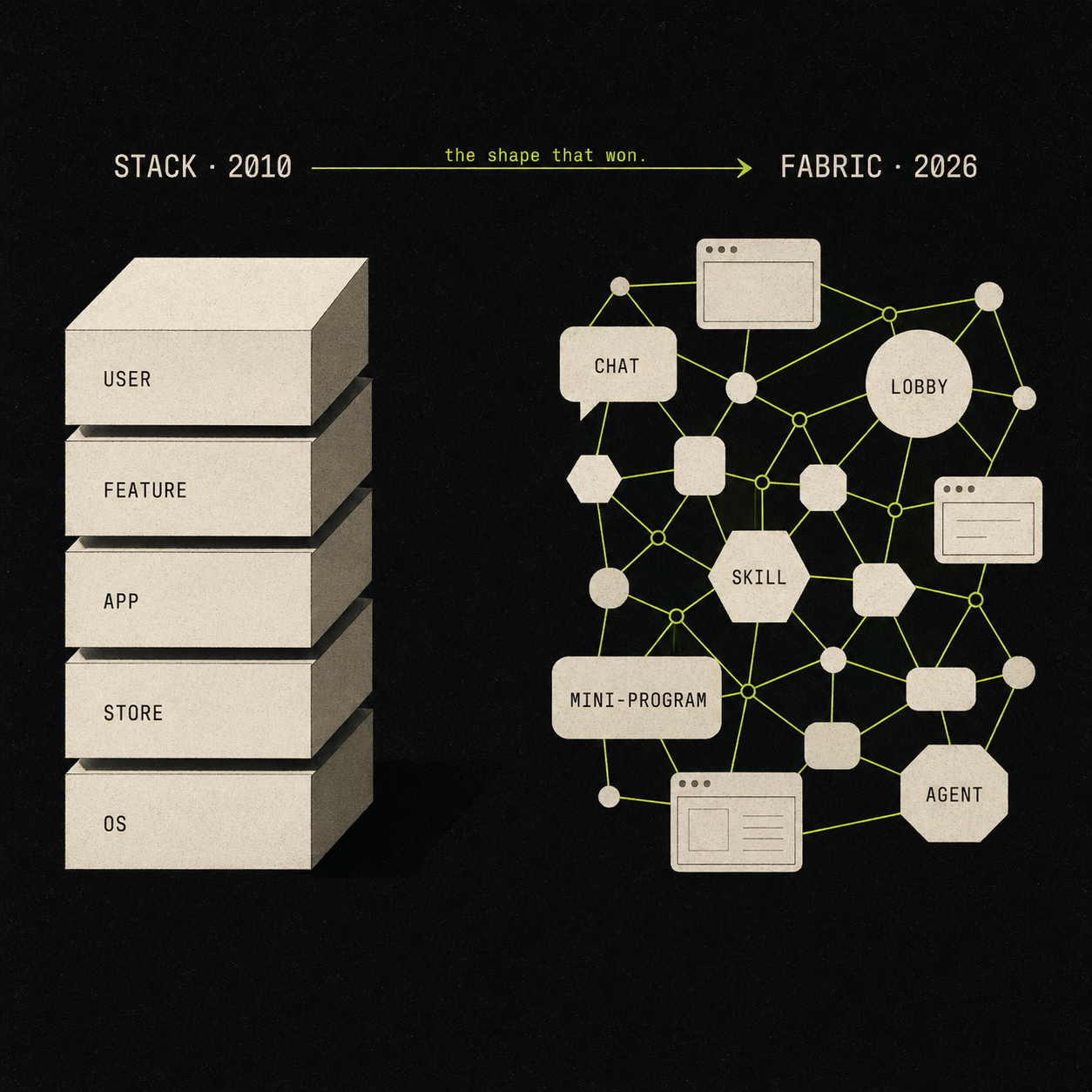
This is superapp logic. WeChat did it with messages. ChatGPT is doing it with prompts. The mechanic is identical. The user lives inside an anchor experience, the experience has a payment rail, and other companies' tools are summoned as needed without ever asking the user to install anything.
If you are building consumer software in 2026 and your distribution plan ends at "we get to the top of the App Store," the agent layer is the surface that is going to swallow you. Not next year. Now.
§ 05 What this means for operators
Five operator moves for 2026 distribution. Most of the work is reframing, not new tactics.
- Stop pitching "the platform." It signals you are still solving the 2015 problem. "Live inside one" is harder, more honest, and closer to what investors actually want to underwrite right now.
- Pick your anchor surface deliberately. Roblox, Discord, ChatGPT, WeChat, an OEM bundle, an iMessage extension, a Shopify theme. These are the new app stores. The one you pick determines your customer, your pricing, your build stack, and your exit. Treat the choice with the same seriousness you used to give Series A vs. seed.
- Build native to the surface, not portable across surfaces. Generic React-Native-everywhere reads as 2017 thinking. The teams winning inside Roblox build with Roblox Studio. The teams winning inside ChatGPT build with the Apps SDK. The teams winning inside WeChat build with Mini Programs. Cross-platform is a tax. Pay it only if you have to.
- Recompute the distribution math. Cost per surface install vs. lifetime value inside that surface, not vs. your MAU dashboard. If you spend $4 to acquire a Roblox player who plays for two hours a day and spends $11 a month inside your experience, you do not care about App Store rank. You care about per-experience CPI inside Roblox.
- Treat "becoming a permanent feature" as a real exit. Sometimes the exit is acquisition. Sometimes it is becoming part of an anchor experience. Disney did not buy Epic. They paid $1.5 billion for a permanent installation inside Fortnite. That is a strategic option that did not exist in 2015 and is now the dominant one in entertainment.
So why is most of the industry still playing the old game?
Why are decks still leading with TAM math from 2015? Why are founders being told to pick a stack before they pick a surface? Why is "platform" still the magic word when the actual platforms have already been built and the names are already on the wall?
Because reframing is harder than retooling. The slides are easier to update than the assumptions underneath them. I have built the wrong slides. I have signed off on the wrong slides for clients. The work is not in the deck. The work is in the assumption underneath. Push the assumption, and the deck rewrites itself.
If you are in advisory or board work, this is the reframe to push founders and teams through before they finish the deck.
§ 06 Self-audit: is your strategy 2015, 2020, or 2026?
Eight questions, weighted scoring. Honest answers, not performative ones.
- 01Where do you expect your next 10,000 users to come from?
- 02Your project's core unit of distribution looks most like:
- 03Which build stack are you betting on hardest?
- 04How do you bill the user?
- 05Where does your audience already spend two or more hours a day?
- 06Your headline acquisition metric is:
- 07Most realistic exit scenario in your model:
- 08Who do you watch most closely as your real competitor?
If you score high in 2015, that is a clue. Either the surface you are betting on is genuinely under-served (rare), or the strategy needs an update (common). The scorecard is not a verdict. It is a starting place for the conversation we would have if you booked an hour with us.
§ 07 The next big platform won't be announced
Platforms used to launch with a keynote. There was a date, a logo, an SDK release, a developer conference. The model assumed the platform was a thing you opted into.
The new shape is the opposite. The next big platform already exists. It is a chat thread, a Roblox lobby, a WeChat conversation, a Fortnite map. The strategic question is not whether to build a platform. It is which one you are already inside, and how native you are willing to get.
But the strategy is not the point. It is downstream of the point.
The reason any of this matters is not strategic. It is human.
People show up to surfaces because something there feels worth showing up for. The fourteen-year-old on Roblox is not optimizing for distribution. She is meeting her friends at a hangout her school has not figured out how to ban. The shopkeeper inside WeChat is not optimizing for surface-native UX. He is selling dumplings to people who already trust the launcher with their Sunday lunch. The college student summoning Spotify inside ChatGPT is not making a strategic call about anchor surfaces. He just wanted music while he wrote.
I have spent twenty years inside MMOs, and the thing I keep relearning is that distribution is downstream of belonging. People move to where their people already are. The platforms that win are the ones that figured out how to be those rooms.
If you build for those people, on the surface they are already on, you do not need a platform strategy. You need a project worth their two minutes of attention. Then their twenty. Then the next two hundred.
The next big platform won't be announced because it does not need to be. It already exists, the people are already inside it, and your job is to meet them there.
That is the work. Strategy is just what we call it when we want the work to sound serious.
Marathon Variety is Mark Laursen and Amber Sutera. We work with founders and companies building inside (and around) the surfaces above. If this argument matches a problem you are solving, say hello.